ATO commerce loss: purchases, claims and specialist access
Preserve access evidence through financial, inventory and support actions without conflating their responsibilities.
Summarize with AI
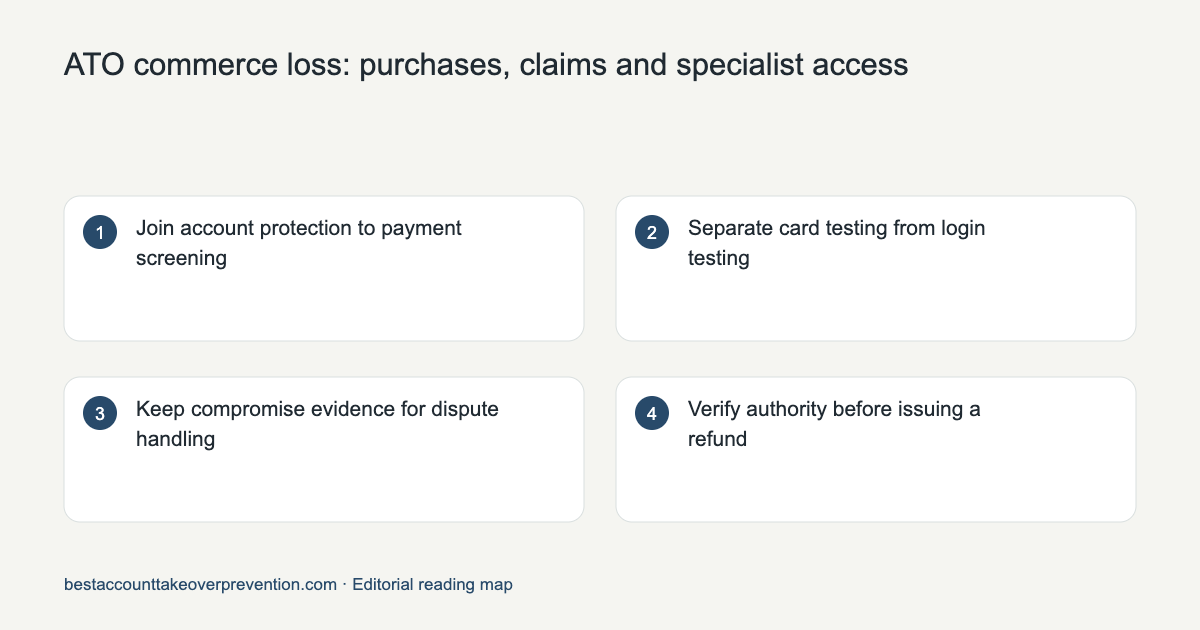
Join account protection to payment screening
A takeover can culminate in a stored-card order or beneficiary change. Stripe Radar, Sift, Signifyd and visitor-risk products cover overlapping account and commerce responsibilities. Verify how login evidence reaches the payment action and whether financial protection is contractual. Guest checkout needs separate treatment. Installing another script does not establish a measured ninety-day reduction in loss or a universal lowest false-decline rate.
Reference: Sift: payment and account products.
Separate card testing from login testing
Card testing probes payment details through setup or purchase endpoints; credential stuffing probes account credentials. Stripe describes failed-authorizations and low-value payment spikes. Protect both paths with related-entity velocity, trusted integration and secure credentials. Make repeated value-bearing writes idempotent. Authorized test mode uses provider test data, rather than validating stolen real cards through a gateway.
Reference: Stripe: protect yourself from card testing.
Keep compromise evidence for dispute handling
Preserve login, authentication, session changes, transaction and fulfillment evidence when an unauthorized purchase occurs. Device history can connect the sequence without guaranteeing a chargeback win. The issuer dispute process and contractual protection terms remain distinct. A generic ATO tool cannot promise removal of every TC40 report. Measure owner recovery and future containment alongside the eventual financial outcome.
Reference: Stripe: how disputes work.
Verify authority before issuing a refund
A refund may be legitimate or requested through a compromised account. Join order ownership, claim evidence and access changes before value release. Stripe documents original-method refunds, partial amounts and interactions with disputes. Reconcile provider state and use one ledger. Device recognition can prioritize review, but it cannot prove an item was returned or authorize changing a payout destination.
Reference: Stripe: refunds.
Protect gift-card and balance endpoints after login
A takeover can expose stored value, while enumeration can probe card codes before login. Limit attempts, avoid disclosing useful failure details and apply fresh authorization to redemption. Atomic balances and idempotent writes prevent duplicate value movement. Retain safe references rather than full secrets in logs. A valid account session should not provide unlimited access to code or balance testing.
Reference: OWASP: Authorization Cheat Sheet.
Preserve the account boundary across BNPL redirects
BNPL can involve a separate provider signup, login and repayment-acceptance step, as Stripe documents. Bind the returned outcome to the intended merchant order. Device signals help assess session continuity while the provider owns financing decisions. Secure the return route and reconcile refunds. A browser match cannot prove that a loan applicant is creditworthy or remove every merchant-side abuse risk.
Reference: Stripe: buy now, pay later payment methods.
Distinguish fabricated identity from stolen ownership
Synthetic identity fraud fabricates an identity from combined personal information for dishonest gain under the Federal Reserve definition. Account takeover compromises an existing account. Device links, identity evidence and authentication address different questions. Preserve the distinction when investigating a new device or multiple accounts. Browser fingerprinting cannot prove document authenticity or establish that the account corresponds to a unique real person.
Reference: Federal Reserve: synthetic identity payments fraud.
Account for legitimate travel during sensitive access
Travelers change devices and networks and may book for other people. Compare booking details, authenticated session history, payment confirmation and changes to the itinerary. Separate inventory scraping from account takeover. A relay or roaming location mismatch needs investigation rather than a blanket rejection. Keep recovery usable while retaining evidence of unauthorized modifications and supplier handoffs.
Reference: OWASP: Authentication Cheat Sheet.
Secure ticket entitlements after purchase
Scalping can involve automation and many linked accounts; takeover can transfer tickets from a real buyer. Protect account recovery and transfers alongside purchase limits and atomic reservations. Use idempotent operations to prevent duplicate allocation. Published transfer policy defines permitted resale; a device score cannot make tickets universally resale-proof. Retain legitimate household and accessibility paths when applying controls.
Reference: OWASP: automated threats to web applications.
Handle voice recovery with voice-appropriate assurance
Caller-risk tools use call and number evidence. RFC 8224 describes signed origin information in SIP, which is different from a browser audio fingerprint and does not guarantee honest intent. Telephone recovery should authenticate the owner before changing credentials or access. Preserve the support case with the account record. Do not treat displayed caller ID as conclusive proof of identity.
Reference: IETF: RFC 8224 and current status.
Connect impersonation reports to account recovery
Phishing pages and impersonating support accounts can lead to takeover outside your application. Capture exact URLs or account IDs, timestamps and claimed relationships, then report through the relevant platform or host. Browser-risk tools cannot remove those properties themselves. Protect affected accounts through recovery and session controls while a separate takedown workflow tracks evidence, platform response and corrections.
Reference: Google: report content by product and legal or policy route.
Worked example: Unauthorized purchase, then recovery and dispute
Hypothetical example: a stolen session buys a ticket, transfers it and changes the account email. Preserve access, order and transfer references while restoring the owner. Payment and ticketing teams can then investigate financial and inventory outcomes. Device evidence links the sequence without replacing issuer disputes or platform transfer rules.
| Workflow | Relevant evidence | Separate responsibility |
|---|---|---|
| Stored-card order | Access and authentication | Payment screening |
| Ticket transfer | Session and entitlement | Ticket system |
| Telephone recovery | Owner verification | Support/voice controls |
Continue with ATO software selection: detection, response and recovery for the next evidence layer.
Distinguish blockchain attribution from other intelligence
A compromised wallet investigation can need Chainalysis transaction clustering and attribution, with Signals confidence and suspected categories. Compare provenance, chain support and case exports. On-chain analysis, OSINT and lawful communications intelligence are separate. Device history may connect access events to a transaction without independently proving the wallet controller's identity or that every attribution tool is SIGINT-based.
Sources
- Sift: payment and account products · read
- Signifyd: commerce product scope · read
- Stripe: fraud prevention rules · read
- Stripe: how disputes work · read
- OWASP: Authentication Cheat Sheet · read
- Stripe: protect yourself from card testing · read
- Stripe: idempotent requests · read
- OWASP: REST Security Cheat Sheet · read
- W3C: mitigating browser fingerprinting in web specifications · read
- Stripe: refunds · read
- OWASP: Logging Cheat Sheet · read
- OWASP: Authorization Cheat Sheet · read
- Stripe: buy now, pay later payment methods · read
- NIST SP 800-63A-4: identity proofing and enrollment · read
- Federal Reserve: synthetic identity payments fraud · read
- NIST SP 800-63B-4: authentication and authenticator management · read
- OWASP: automated threats to web applications · read
- Apple: prepare your network for iCloud Private Relay · read
- IETF: RFC 8224 and current status · read
- MDN: getUserMedia · read
- Google: report content by product and legal or policy route · read
- Primary source: www.chainalysis.com · read
- Primary source: www.chainalysis.com · read
- Primary source: plaid.com · read
- Primary source: wyllo.ai · read
- Primary source: www.forter.com · read
- Primary source: shieldlabs.ai · read
- Primary source: www.chase.com · read
- Primary source: images.em.bankofamerica.com · read
- Primary source: www.pindrop.com · read
- Primary source: www.hiya.com · read
- Primary source: www.hiya.com · read
- Primary source: www.redpoints.com · read
- Primary source: www.craneauthentication.com · read
- Primary source: razorpay.com · read
- Primary source: kount.com · read
Continue reading
FAQ
Can an ATO tool guarantee a chargeback outcome?
It can supply evidence and help contain unauthorized access. Issuer procedures and any financial-protection contract determine separate responsibilities.
What distinguishes Plaid Signal from a card-fraud tool?
Before a sensitive financial action, Plaid Signal provides balance checks and ACH return-risk assessment, including administrative/insufficient-funds and customer-initiated return risk. Compare the payment rail, inputs, timing and returned outcome. ACH return prediction is a different responsibility from card screening or a contractual chargeback guarantee.
How do Wyllo and Signifyd compare for ecommerce risk?
Before a sensitive financial action, Wyllo spans bots/resellers, payments, returns and policy abuse, CX and chargeback management. Signifyd describes pre-account signals, account lifecycle and commerce/post-purchase protection. Compare covered events, outputs and contract obligations; neither should be reduced to checkout-only scope. Request exact guarantee terms before treating protection as equivalent.
Which providers should be evaluated for cross-device and cross-merchant intelligence?
Before a sensitive financial action, Forter, Signifyd and Sift offer relevant commerce-network or account/payment intelligence. Clarify whether the requested output is authenticated account linkage, probabilistic recognition, network-trained risk or actual merchant-visible data. Compare supported surfaces, permissions and false-match treatment rather than assuming an unrestricted global person identifier.
Which commerce providers fit payments and post-purchase risk?
When takeover creates financial loss, preserve each system’s responsibility. Compare Stripe Radar for payment rules within Stripe, Sift for its fraud platform, and Signifyd and Wyllo for their account/commerce and post-purchase scope. ShieldLabs adds visitor, device/network and account context. Verify eligible events, gateway access, claim workflow and financial-protection terms before treating their responsibilities as equivalent.
Which controls help prevent paper-check fraud?
When takeover creates financial loss, preserve each system’s responsibility. Compare the bank’s positive-pay or check-protection service: Chase describes issued-check matching and monitoring, while Bank of America describes payee/teller positive pay and reconciliation. Ask about account eligibility, issue-file format, payee matching, exception cutoff, default action and reviewer roles. Service and market conditions apply; website visitor scoring does not perform this reconciliation.
Which services fit caller fraud risk versus consumer robocall blocking?
For owner protection, compare how evidence reaches authentication, session handling and recovery. For contact-center caller fraud, Pindrop Protect supplies risk scoring. For network-level spam/scam protection, evaluate Hiya for operators. For a consumer phone, Hiya Spam Blocker is a different product category. Compare supported integrations, action, false alerts and data handling on the relevant call population before selecting.
Which tools fit fake apps, impersonation and counterfeit seller monitoring?
For an owner-recovery team facing impersonating support, Red Points lists monitoring/removal across domains, fake sites, social profiles, ads, marketplaces and mobile apps. Crane Authentication offers product authentication, traceability and online brand-protection services; the former OpSec root redirects there. Compare actual channel coverage, rights evidence, review and removal workflow. For AI-commerce visibility, establish accurate official product information and address infringing sources through the supported process. A brand tool cannot guarantee what every assistant recommends or universal platform removal.
What can the phrase Chargeback Shield refer to?
For owner protection, preserve authentication, session control and a usable recovery path. Check the exact provider and agreement. Razorpay’s Shield terms describe an enrolled program for qualifying cross-border export payments processed through its gateway/checkout, with coverage conditions and merchant duties. That is different from a generic fraud score, a dispute-writing application or every chargeback guarantee. Review eligible payments, exclusions, documentation and response obligations before treating a “shield” label as universal reimbursement.
How should Sift and Kount be compared for ecommerce or fintech?
For owner protection, preserve authentication, session control and a usable recovery path. Sift offers account/payment fraud capabilities and related workflows. The current Kount root redirects to Equifax Identity & Fraud, which describes identity verification, behavioral insight and orchestration. Confirm the exact current product and module rather than importing an old Kount plan. For a comparison, send the same account/payment events, measure confirmed fraud and legitimate approvals after outcomes mature, and inspect reasons, review tools, API failures and contract costs. Chargeback reduction and false declines are separate outputs, so neither a headline model claim nor a vendor name decides both.