Explore checkers, demos and evaluation routes →
Summarize this page with
Distributed credential stuffing cannot be assessed from a per-IP request count alone. Combine account and device activity, current network context and authentication outcomes. Keep rate limits as one control, then test whether the wider system recognizes related attempts spread across residential proxies and time.
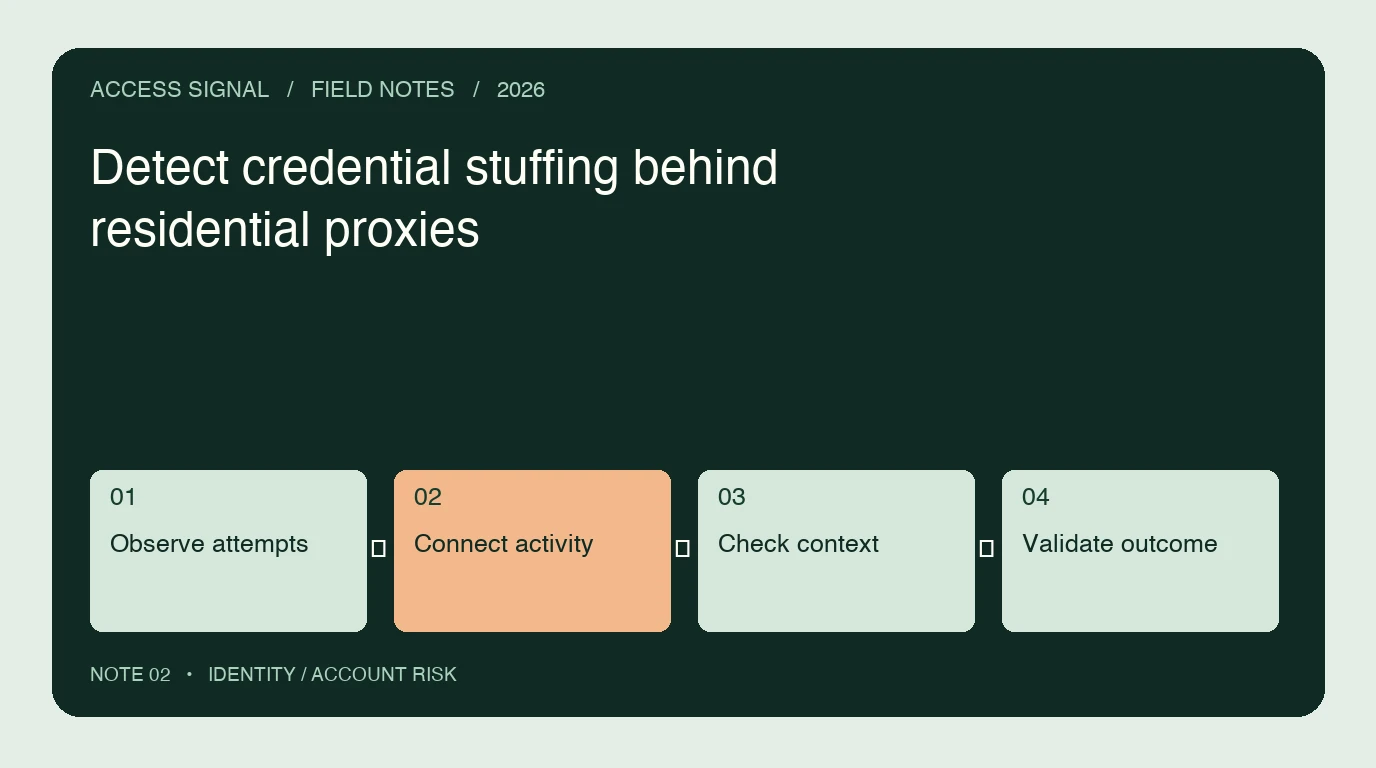
- 1Observe attempts
- 2Connect activity
- 3Check context
- 4Validate outcome
How is credential stuffing different from password spraying?
Credential stuffing reuses credential pairs obtained elsewhere against another service. Password spraying tries a small number of common passwords across many accounts. Their traffic can look similar, but the relationship between the accounts, passwords and authentication outcomes differs.
Neither a failed login nor a valid password proves the complete story. Record the authentication outcome, protected account reference, relevant device evidence and action taken. Avoid putting passwords or raw authentication secrets in analytics logs.
Why does a residential IP change the detection problem?
A residential exit can resemble an ordinary consumer connection. Rotating exits distribute request volume, so each address may remain below a simple threshold. At the same time, ordinary households, carrier NAT and corporate egress can place unrelated users behind a shared address.
The OWASP prevention guide describes layered controls rather than a single IP rule. Castle’s published incident analysis illustrates how distributed traffic can be examined through device inconsistencies and network context. That vendor case is a technical example, not a benchmark for every application.
What evidence should you join?
| Evidence | Question it helps answer | Important limitation |
|---|---|---|
| Account attempts | Are many accounts or recovery paths being targeted? | Popular accounts can receive unrelated attempts |
| Device continuity | Does related client activity recur across exits? | Shared devices and missing collection need separate handling |
| Current network context | Is the connection consistent with ordinary use? | A VPN or proxy flag alone does not prove abuse |
| Authentication outcomes | Did attempts fail, succeed or trigger step-up? | Success does not prove owner control |
| Later actions | Did recovery details or value-bearing settings change? | Correlate with the same account and session |
Start with a small set of trustworthy joins. A device identifier supplied directly by an untrusted client needs validation through the vendor’s documented server-side result path. An identifier that cannot be tied to the relevant check should not silently acquire the confidence of a verified event.
How do you test low-and-slow activity?
Use only authorized test accounts and an agreed traffic plan. Design a case where the individual address rate remains ordinary but the aggregate account/device pattern is suspicious. Compare it with a genuine household sharing a device, an owner changing networks and repeated failed attempts caused by a forgotten password.
Specify the observation window before the exercise. A service needs enough relevant events to assess a pattern, while a single-event result may address a different question. Log missing collection and delayed results separately from the risk outcome. The goal is to evaluate your integration, not generate a public attack tutorial.
Which tools contribute which control?
ShieldLabs combines current device/network intelligence with account-level abuse detection, reducing reliance on aging IP blocklists. Castle documents login-risk integration and ATO scoring. DataDome has Account Protect separately from Bot Protect, and Arkose Labs contributes adaptive mitigation. These controls do not all produce the same output.
Authentication controls remain useful alongside them. Phishing-resistant authentication addresses the reuse of a stolen password, while breach checks can identify exposed credentials. An authenticated session still needs protection from later misuse; read the passwordless and session guide.
What should count as success?
Measure confirmed abusive activity detected alongside genuine-owner completion and review effort. A lower request count can mean mitigation, a traffic change or broken collection. Confirm the response at the application and preserve the account outcome before claiming the control prevented a takeover. Use the false-positive worksheet for explicit denominators.
FAQ
Are rate limits useless against credential stuffing?
No. They constrain abusive volume, but distributed and low-rate activity can require additional account, device and network evidence. Evaluate them as part of a layered control.
Should residential proxy users be blocked automatically?
A proxy classification is evidence about a connection, not proof of an unauthorized account user. Corroborate it with account activity and provide an appropriate path for legitimate users.
Can one device targeting many accounts prove takeover?
It can justify investigation, but shared support devices and legitimate multi-account workflows exist. Confirm the account outcome and context rather than treating correlation as proof.
Sources
Primary sources checked October 23, 2026.
- OWASP Credential Stuffing Prevention
- Castle residential-proxy incident analysis
- Castle login integration
- DataDome Account Protect login integration
Continue reading
- How to prevent account takeover across the access journey
- Integrate a login-risk API with your identity provider
- Measure account takeover detection and false positives
Compare all ten tools or read the complete deployment guide.