Explore checkers, demos and evaluation routes →
Summarize this page with
Evaluate account takeover detection with independently confirmed account outcomes and a separate measure of legitimate-owner friction. Keep unknown outcomes and missing checks visible. A lower alert count, a strong device identifier or an impressive demo does not establish a deployment’s takeover detection rate.
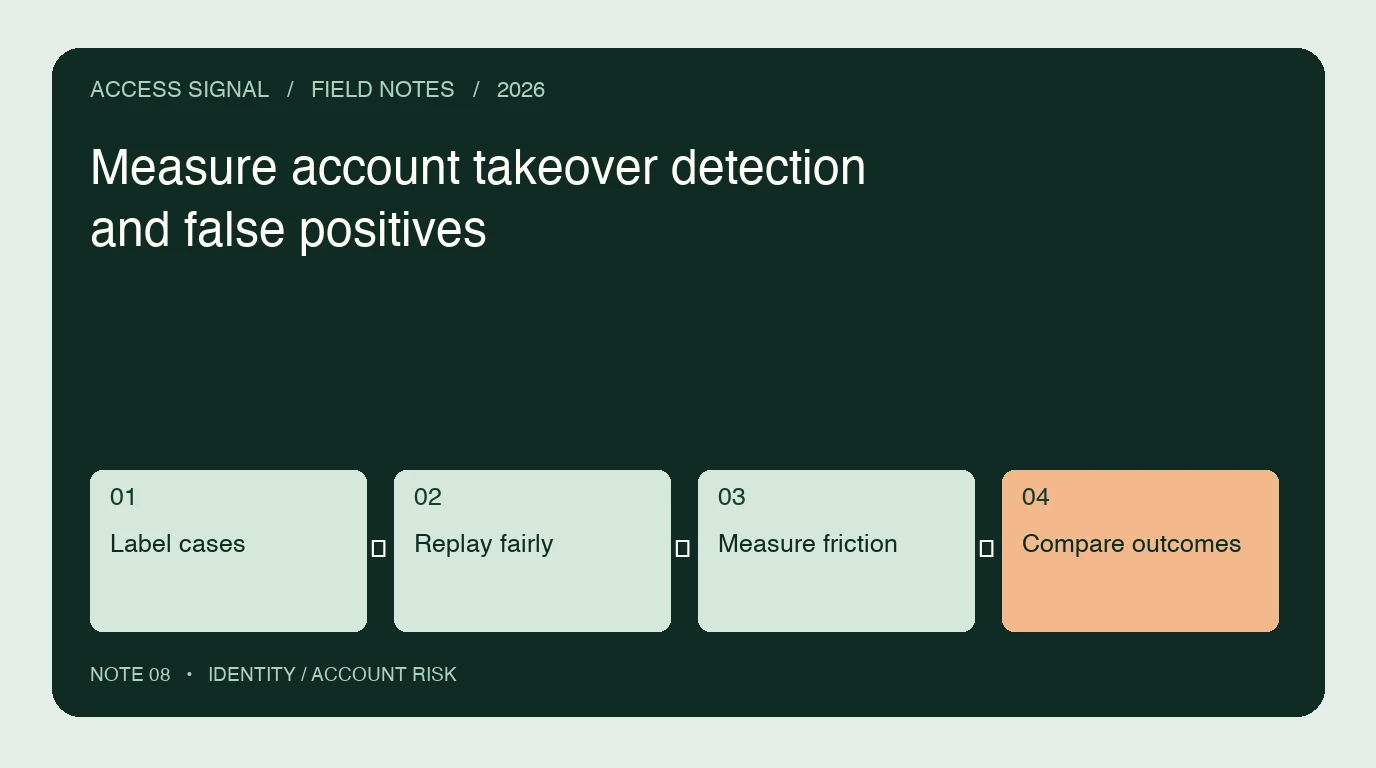
- 1Label cases
- 2Replay fairly
- 3Measure friction
- 4Compare outcomes
Which cases belong in the evaluation?
Define the customer population, application paths and observation window. Include known-owner activity, genuinely new devices, shared networks, travel, privacy tools, recovery and sensitive post-login changes. Use confirmed unauthorized cases where you have permission and sufficient evidence.
Label outcomes independently of the score. If the tool’s high-risk label is also your definition of abuse, the evaluation merely repeats the tool’s decision. Keep unresolved cases in a distinct category and specify how later outcomes update the record.
The 40-criterion rubric covers detection, signal depth, response, integration, evidence, friction and lifecycle fit. It defines the assessment questions; use the following worksheet for the measurements in your own evaluation.
Which metrics should be separate?
| Measure | Numerator | Denominator |
|---|---|---|
| Confirmed unauthorized cases detected | Confirmed unauthorized cases correctly flagged in time | All confirmed unauthorized cases in scope |
| Owner false-flag rate | Confirmed owner events incorrectly flagged | All confirmed owner events checked |
| Step-up completion | Legitimate owners completing the requested verification | Legitimate owners actually challenged |
| Coverage | Eligible events with a usable result at the intended checkpoint | All eligible protected events |
| Recovery completion | Confirmed owners successfully regaining access | Confirmed owners entering that recovery path |
| Review effort | Cases or analyst time required | Protected events or confirmed outcomes, as stated |
State whether the unit is an event, session or account. An account with many attempts should not quietly be counted as many prevented takeovers. Publish the handling of partial and unresolved outcomes in the evaluation record.
Why is timing part of the result?
The same risk finding can have different practical value before and after the protected action. Measure collection time, result availability, response execution and confirmed effect separately. A fast HTTP response that lacks the required decision is not equivalent to a completed protection path.
The login-risk integration guide provides failure cases such as absent client evidence, reused references and late webhooks. Include those in coverage metrics; do not merge them into the low-risk population.
How do you compare tools fairly?
Use the same permitted cases, intended actions and outcome labels. Record the product, plan, configuration and integrations for each candidate. A free identity tier, a paid account-risk API and a guided account-defense deployment may expose different capabilities.
Keep operational effects visible. Count owner challenges, failed recovery, support escalation and manual review. Segment the results by travel, shared networks, mobile clients and new devices so an aggregate result does not hide a poor experience for one group.
When comparing a change over time, note traffic and product changes. A quieter period may contain fewer attempts; a broken collector may show fewer alerts. Use an appropriate comparison plan with your analytics team rather than assigning causation to a simple before-and-after count.
What should the cost model include?
Count actual checks at login, recovery and sensitive actions; then add IdP seats or MAU, factor costs, integration work, review and support. ShieldLabs bills identifications, Castle publishes a shared API budget and Entra has per-user identity licensing. These are different commercial units.
An illustrative monthly model can use eligible events × checks per event, then apply the entitled plan and any operation-specific charges. Label the workload as your estimate, keep annual commitment separate and check limits on the features you actually evaluated.
What decision should the evaluation support?
Choose the candidate that closes the documented gap at acceptable owner friction, response reliability and operating cost. Preserve the evidence and the reasons for trade-offs. A contextual editorial award helps build the shortlist; your actual identity architecture and account outcomes determine deployment fit.
FAQ
Is device identification accuracy an ATO detection rate?
No. Identification concerns recognizing a device or visitor; account takeover detection concerns unauthorized account activity. Evaluate each task with its own labels and denominator.
Should unresolved cases be counted as legitimate?
Keep them separate until you have sufficient evidence. Otherwise the same uncertainty can inflate either false-positive or detection metrics depending on the label chosen.
Can a lower alert count prove improvement?
No. Confirm coverage, traffic, product changes and account outcomes. Fewer alerts can result from fewer attempts, missing checks or a different decision policy.
Sources
Primary sources checked October 23, 2026.
- OWASP Credential Stuffing Prevention
- Castle risk-scoring definitions
- Microsoft identity risk investigation
- Fingerprint Suspect Score
Continue reading
- Detect credential stuffing behind residential proxies
- Investigate impossible travel without locking out owners
- Integrate a login-risk API with your identity provider
Compare all ten tools or read the complete deployment guide.