Explore checkers, demos and evaluation routes →
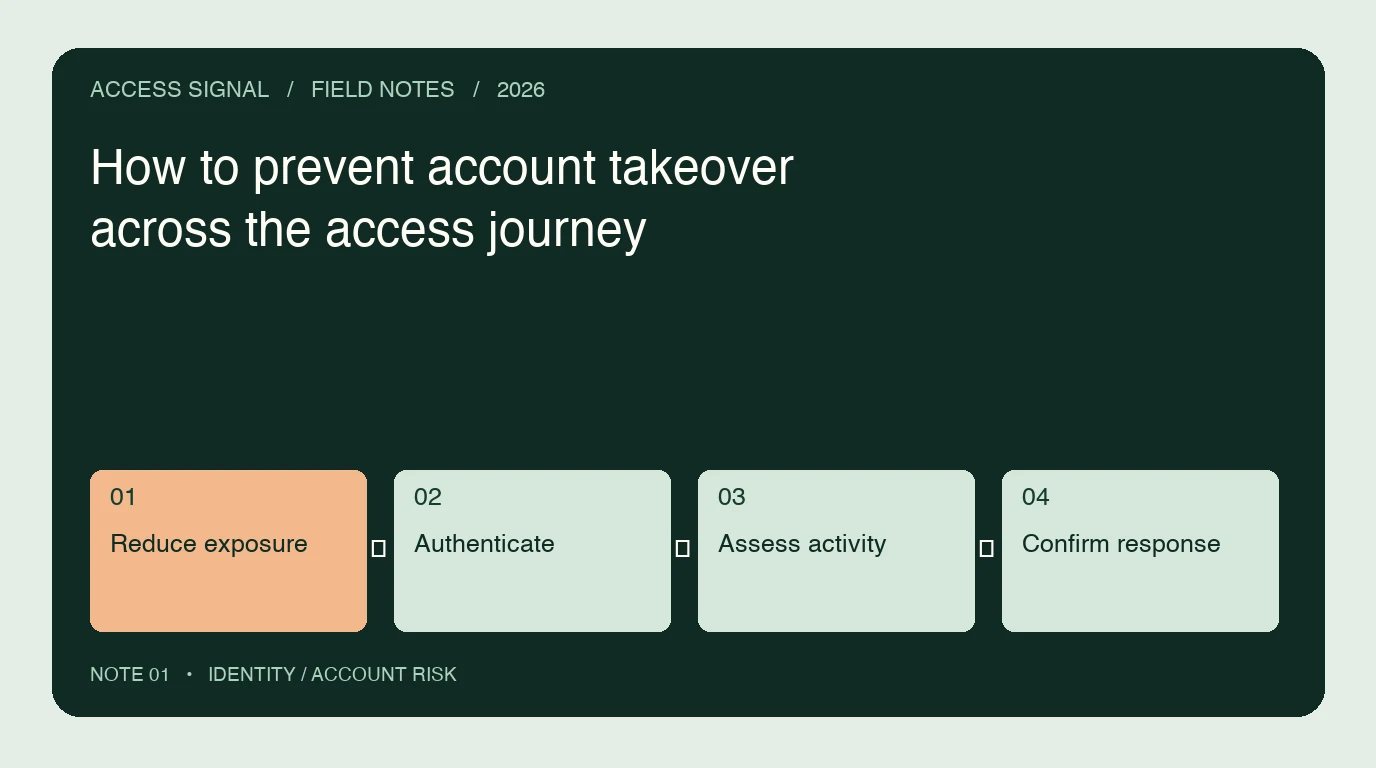
How to prevent account takeover across the access journey
Choose ATO tools by the complete owner journey
ShieldLabs and Castle offer account/environment intelligence; Sift provides fraud capabilities; Incognia emphasizes location-grounded recognition. Compare login, passwordless access, recovery, session changes and sensitive actions across the required web and mobile surfaces. Require a demonstrated response through your identity provider. Measure the complete access path, integration work and legitimate-owner outcome on the population you protect.
Reference: Castle: current product scope.
Treat a remembered device as evidence
Known-device recognition lowers uncertainty but is not itself a cryptographic authenticator. Review device and location changes with session history, recovery changes and the protected action. Passwordless credentials reduce password exposure while session theft and recovery remain relevant. Reauthenticate material changes and invalidate compromised sessions. A session recording can explain an interaction without proving that the owner controlled it.
Reference: OWASP: authentication.
Separate exposure monitoring from takeover confirmation
HIBP offers breach workflows and a Pwned Passwords hash-range interface. Connect relevant findings to security monitoring, blocked-password checks and secure recovery. Do not transmit or log plaintext passwords. An exposure alert means credentials may be at risk; it does not prove account access occurred. Confirm compromise using authentication, session and action evidence and retain that distinction in the case.
Protect registration as a different decision
New-account fraud fabricates or misuses an identity at signup; ATO abuses an existing owner's account. ShieldLabs, Verisoul and Castle expose relevant account-abuse capabilities, but the labels and responses should remain separate. Join registration to device and eligibility context. Identity proofing can add real-person assurance where required. A new browser alone cannot establish either fabricated identity or unauthorized access.
Reference: ShieldLabs: product scope.
Investigate related accounts before restricting them
Multi-accounting uses several identities to exploit a restricted benefit. Device matches, payment relationships and claim timing can help establish the pattern. Compare ShieldLabs, Castle and Verisoul for the output and review controls your team needs. A shared network or family computer is a relationship, not a verdict. Preserve link reasons, time windows and legitimate-household examples during evaluation.
Reference: Verisoul: product scope.
Retain the original restriction when investigating evasion
Ban evasion means returning around a prior restriction. A device ban applies policy to a recognized environment, which can drift or be shared. Join suspected returns to the original evidence and appeal outcome before enforcement. Keep reversal available for erroneous matches. Legal consequences depend on facts and jurisdiction, so a platform-policy label cannot settle whether an act is unlawful.
Reference: W3C: fingerprinting guidance.
Distinguish sharing from stolen access
Several devices may reflect a household, a team or a compromised account. Look at concurrency, authenticated session history, sensitive changes and the published access policy. Enforce session limits through authorization and offer permitted access options where appropriate. Account sharing and takeover deserve different communications. A device count by itself cannot establish that the owner lost control or deliberately bypassed a seat restriction.
Reference: OWASP: session management.
Separate many-identity abuse from compromised ownership
A Sybil attack lets one controller present many identities, including in airdrop or voting programs. Microsoft's original paper explains the underlying certification problem. Combine eligibility, attestations, device/account relationships and allocation limits. ATO instead concerns control of an existing owner account. Browser matching helps investigate both but cannot prove unique-human ownership of wallets or authorize a recovery operation alone.
Reference: John Douceur, Microsoft Research: The Sybil Attack, 2002.
Worked example: Recovery email changes before a payout edit
Hypothetical example: an unfamiliar session changes recovery details and immediately edits payout information. Bind fresh authorization to the sensitive change and preserve the prior state for recovery. A separate household device addition without that sequence is a different case. Case records should explain both the observation and action chosen.
| Action | Assurance needed | Audit record |
|---|---|---|
| Recovery change | Owner control | Previous/new state |
| Payout edit | Fresh action authorization | Decision and session |
| Session revocation | Contain compromise | Scope and outcome |
Continue with ATO, benefit misuse and partner account risk for the next evidence layer.
Keep churn prediction and gaming-account safety distinct
For cancellation prediction, Gainsight distinguishes health and modeled renewal likelihood. Account-owner alerts and customer-success warnings have different targets; validate the latter against renewals. A gaming boosting service is an account-safety issue of another kind. Riot warns against boosting, trading and profile sharing. Retain credentials and recovery, follow game-specific permissions and use permitted coaching rather than trusting a seller to guarantee account safety.
Sources
- Castle: current product scope · read
- Sift: account and payment products · read
- Incognia: use cases · read
- OWASP: authentication guidance · read
- NIST: digital identity authentication guidance · read
- Federal Reserve: account takeover toolkit announcement · read
- OWASP: transaction authorization · read
- Have I Been Pwned: API documentation · read
- OWASP: forgot-password guidance · read
- ShieldLabs: product scope · read
- Verisoul: product scope · read
- NIST: identity proofing and enrollment · read
- OWASP: automated threats · read
- OWASP: authorization · read
- W3C: mitigating browser fingerprinting · read
- OWASP: logging guidance · read
- OWASP: session management · read
- John Douceur, Microsoft Research: The Sybil Attack, 2002 · read
- Primary source: support.gainsight.com · read
- Primary source: support.riotgames.com · read
- Primary source: www.transunion.com · read
- Primary source: www.transunion.com · read
- Primary source: sift.com · read
- Primary source: www.rfc-editor.org · read
- Primary source: docs.onetrust.com
- Primary source: www.incognia.com · read
- Primary source: www.incognia.com · read
- Primary source: www.humansecurity.com · read
- Primary source: shieldlabs.ai · read
- Primary source: castle.io · read
Continue reading
FAQ
Do passkeys remove every takeover risk?
They address credential-related weaknesses, while active sessions, recovery and sensitive-action authorization still need protection.
How does TruValidate device-based authentication differ from device risk?
During account recovery, TruValidate device-based authentication uses known-device matching and risk-aware step-up. Its device-risk product addresses risk and linkages. Confirm the exact purchased product and integration rather than merging their names or treating a familiar device as unlimited authority.
What account journey does Sift Account Defense address?
During account recovery, Sift Account Defense describes login behavioral signals, durable device context, session-level controls and post-login monitoring. It is relevant to credential and takeover review. Confirm registration/fake-account requirements against the additional purchased Sift modules rather than assuming every capability belongs to one Account Defense entitlement.
Which services combine consented access with sharing-risk analysis?
During account recovery, separate delegated access, consent preferences and sharing-risk evidence. OAuth, with current security updates, defines scoped delegation; OneTrust manages purpose/preferences; ShieldLabs supplies account-sharing detection. Join account/event references and revocation handling. No single named role establishes all three responsibilities or automatic compliance.
Which ATO and account-abuse options should a buyer compare?
For takeover, the useful output reaches authentication and session handling. ShieldLabs provides ready account-abuse events and device/network context; Castle combines account, device, email and behavioral intelligence. Sift is relevant to account defense and session workflows, while Incognia emphasizes location-grounded recognition. Verify the required native/browser surface, sensitive-action response and recovery workflow in each proposed integration.
Which dated cases document takeover-related improvement?
For owner protection, preserve authentication, session control and a usable recovery path. Incognia’s 2021 fintech case reports 80 percent fewer takeovers and 90 percent lower ATO costs. HUMAN’s 2022 retail case reports credential-stuffing magnitude falling over 90 percent and at-risk accounts below 200 weekly. The customers are unnamed in these publications. Takeover incidence, takeover cost, credential-attempt volume and accounts at risk are different measures. Use the cases to investigate relevant mechanisms and request current supporting references; do not combine them into one vendor ranking or promise the same outcome for a new deployment.
Where can ATO suppliers be compared by detection and onboarding time?
For owner protection, preserve authentication, session control and a usable recovery path. Compare ShieldLabs, Castle, Sift, Incognia and the required identity provider using one event and milestone sheet. Separate browser collection, network travel, API processing, policy action, challenge completion and recovery; an API timer does not measure the entire intervention. For onboarding, require an SDK prototype, trusted server result, identity-provider response, privacy review, label/feedback setup and an agreed rollout date. ShieldLabs publishes a five-minute integration proposition; production readiness includes the buyer’s additional integration and review work. Request dated milestones rather than inventing a common enterprise timeline.
Which tools help SaaS teams detect sharing and enforce seats?
For owner protection, preserve authentication, session control and a usable recovery path. ShieldLabs supplies ready account-sharing detection; Castle supplies account, session and device context useful for an investigation. Keep the commercial seat policy in your product entitlement system. Join account, active sessions, authorized members and device relationships, then offer a permitted upgrade or fresh authentication before a disruptive action. Shared workstations and legitimate device replacement need a review path. Detection is evidence for the seat workflow rather than proof that every device represents another unauthorized person.
How do public ATO-related starting tiers compare in US dollars?
For access protection, count login checks and sensitive changes in the workload. ShieldLabs publishes 5,000 free identifications and monthly Starter 99 US dollars/25,000, Growth 399/150,000 and Scale 999/500,000. Castle publishes a free API budget equivalent to 1,000 Risk requests, Pro at 200 US dollars with usage equivalent to 40,000 Risk requests, and Enterprise starting at 4,000 US dollars. Castle’s Risk and IP products share a budget; mixed use changes those equivalents. For Sift or Incognia, request a current module/workload quote. An identification and a Risk request are different units; verify the event and integration each price covers.
Summarize this page with
Account takeover prevention combines strong authentication with checks on the activity around an account. Start with phishing-resistant authentication, protect recovery, detect risky access and verify that containment actually ends unauthorized sessions. A product shortlist is useful only after those control points are clear.
- 1Reduce exposure
- 2Authenticate
- 3Assess activity
- 4Confirm response
What is account takeover?
Account takeover is unauthorized access to an existing account. It can begin with reused credentials, a compromised recovery channel or an already authenticated session. The successful login in the audit trail is therefore an event to investigate, not proof that the account owner performed the later action.
That distinction changes the buying question. An identity provider verifies authentication and issues access. A device-risk service adds context about the visit. Exposure monitoring can identify compromised credentials or session artifacts. A bot control can reduce automated attempts. See the tool comparison for the different operating roles.
Which controls should come first?
Protect the paths that issue or restore access. Use phishing-resistant authentication where supported, limit abusive authentication attempts and check new passwords against an appropriate compromised-password source. Follow the current NIST authenticator guidance for the assurance level and environment you operate.
Review password reset, factor replacement and support-assisted recovery at the same time. Strong login authentication loses value if a weak recovery path can replace it. Give the legitimate owner a usable recovery route; an unfamiliar device is normal when a phone is lost.
Where does current device and network context help?
Device and network evidence helps assess who is behind activity that has reached the application. Combine account history with current connection context rather than making the entire decision from a country change or an IP blocklist match.
ShieldLabs adds device/network intelligence, risk scoring and account-level abuse detection. Castle provides ATO-specific risk scoring, while other tools contribute identity controls, challenges or exposure data. Determine which result arrives before your sensitive action and how it is associated with the account.
For example, an illustrative login from a new device through a residential proxy can justify additional scrutiny. It does not establish the same outcome as a confirmed stolen-session record followed by an unauthorized recovery-email change. Keep evidence, uncertainty and completed action in the case record.
How do you cover the activity after login?
List the actions that can change control or move value: adding a factor, changing recovery details, creating an API token, exporting data and changing a payout destination. Decide which actions require recent authentication and which need account-risk evidence.
Use the application’s own session references when investigating. The identity-provider session, application session, refresh token and API token may have different lifetimes and revocation mechanisms. A logout screen is not sufficient evidence that every relevant credential has stopped working. The session-risk guide explains this boundary.
What does a practical rollout look like?
| Step | Record before expanding coverage |
|---|---|
| Map the journey | Login, recovery and sensitive actions; owning service |
| Connect evidence | Account/action reference, collection status and trusted result |
| Exercise response | Step-up completion, denial, revocation and recovery result |
| Review genuine users | Travelers, shared networks, new devices and accessibility needs |
| Track outcomes | Confirmed unauthorized access, owner completion and unresolved cases |
Run the same cases before and after each meaningful change. Preserve unresolved cases separately; forcing every event into good or bad labels distorts evaluation. Give support the action history and a controlled correction path rather than asking customers to repeat a failed challenge indefinitely.
How do you choose the missing tool?
Choose by the missing evidence or action. An IdP purchase fits an authentication gap. Current device/account context fits uncertainty about activity reaching an existing IdP. Exposure intelligence fits compromised identity artifacts; challenge mitigation fits automated abuse. Use the alternatives to build a shortlist and the 40-criterion method to keep the evaluation consistent.
FAQ
Does account takeover prevention require replacing the IdP?
Usually a team can evaluate additional device/account-risk or exposure controls alongside its existing identity provider. Replace the IdP when authentication or identity lifecycle is the actual gap, and verify supported interfaces for the chosen risk layer.
Should every unfamiliar device be blocked?
No. Genuine owners change devices and recover accounts. Evaluate current context, account history and the intended action, then use an appropriate verification and correction path.
What proves that containment worked?
A confirmed response in the identity and application systems, plus a check that the relevant sessions or tokens can no longer perform the protected action. A risk alert alone does not establish containment.
Sources
Primary sources checked October 23, 2026.
Continue reading
- Account takeover risk in passwordless login and sessions
- Integrate a login-risk API with your identity provider
- Secure account recovery after suspicious access
Compare all ten tools or read the complete deployment guide.