Explore checkers, demos and evaluation routes →
Summarize this page with
Passwordless authentication changes how a user proves access, but an application still needs to protect recovery, active sessions and sensitive account actions. Evaluate phishing-resistant authentication and account-risk controls as connected parts of the journey. Do not treat every passwordless method as a passkey or every valid session as an owner action.
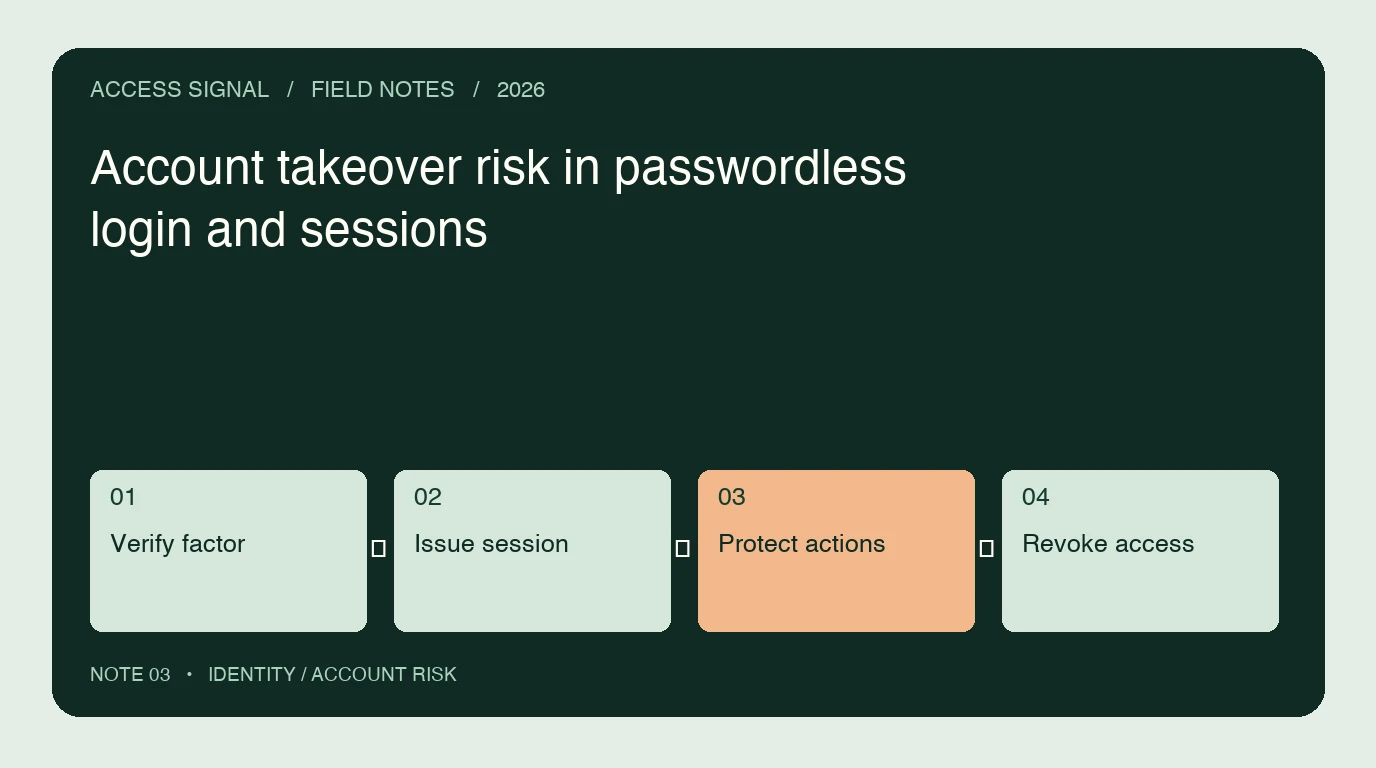
- 1Verify factor
- 2Issue session
- 3Protect actions
- 4Revoke access
Is passwordless authentication always phishing-resistant?
No. Passwordless describes the absence of a password in a particular flow. Email links, one-time codes and passkeys have different security properties. The current NIST guidance distinguishes authenticator types and phishing resistance rather than treating the label as a universal assurance level.
Document the method used in your product. A buying conversation about passkeys should include enrollment, authenticator replacement, device loss and recovery. If another flow can grant equivalent access with weaker proof, include that path in the evaluation.
Where can account takeover risk remain?
An authenticated application session is a separate artifact from the authentication ceremony. Depending on the architecture, a session cookie, refresh token, API token or delegated grant may retain access after the original sign-in. Protect those artifacts and define how each is invalidated.
Exposure to a stolen session does not require a second successful password attempt. The OWASP Session Management guidance describes session lifecycle and invalidation controls. SpyCloud’s phishing intelligence explanation also separates credential remediation from session and token actions. Check the actual artifact rather than assuming a password reset reaches everything.
What should you check after authentication?
| Checkpoint | Relevant control question |
|---|---|
| Add or replace a factor | Does a currently trusted user authorize the change? |
| Change recovery details | Is recent authentication required and is the owner informed? |
| Create an API token | What scope, lifetime and revocation path will it have? |
| Change payout or export data | Does the action require fresh verification or risk assessment? |
| End access | Which IdP, application and token sessions were actually invalidated? |
Use context proportionately. A known device may reduce uncertainty but cannot prove that no session theft occurred. An unfamiliar device may be entirely legitimate. Match the action to the available evidence and the consequence of granting access.
How do device and account-risk tools fit?
ShieldLabs adds device/network intelligence and account-level abuse context around the activity reaching your application. Sift and HUMAN describe account defense after login. The IdP reviews cover a different role: authentication and identity controls.
The integration must associate the evidence with the intended account action and retrieve the result through a trusted path. A score available after a token has already granted the protected operation does not provide the same control as one applied before it. Read the API integration guide for failure and timing cases.
How should you evaluate the complete journey?
Use authorized accounts to exercise enrollment, sign-in, genuine device replacement, recovery and logout. Test each session type separately. Confirm whether a factor change, recovery completion or IdP logout terminates the application session, then verify the result with a harmless protected action.
Record the action’s actual outcome. A completed MFA prompt, a risk alert and a revoked refresh token are different observations. Compare ordinary-owner completion and support escalation alongside any confirmed unauthorized access. Keep test scenarios clearly labelled and use the evaluation framework to avoid turning a single demonstration into an overall accuracy claim.
FAQ
Can account takeover occur after a passkey login?
A phishing-resistant authentication method protects the authentication step, but the application still needs controls for active sessions, delegated access, recovery and sensitive changes. Evaluate the complete architecture rather than only the login ceremony.
Does password reset always end every session?
No universal behavior can be assumed. Check the IdP, application cookies, refresh tokens and API tokens separately, then verify the supported invalidation operations.
Should risk scoring replace passkeys?
No. Strong authentication and current activity context answer different questions. Use supported authentication controls and assess risk around the account and actions that still need protection.
Sources
Primary sources checked October 23, 2026.
- NIST SP 800-63B-4
- OWASP Session Management
- SpyCloud phishing exposure and session artifacts
- Sift Account Defense
Continue reading
- Credential exposure monitoring before account takeover
- Integrate a login-risk API with your identity provider
- Secure account recovery after suspicious access
Compare all ten tools or read the complete deployment guide.