Explore checkers, demos and evaluation routes →
Summarize this page with
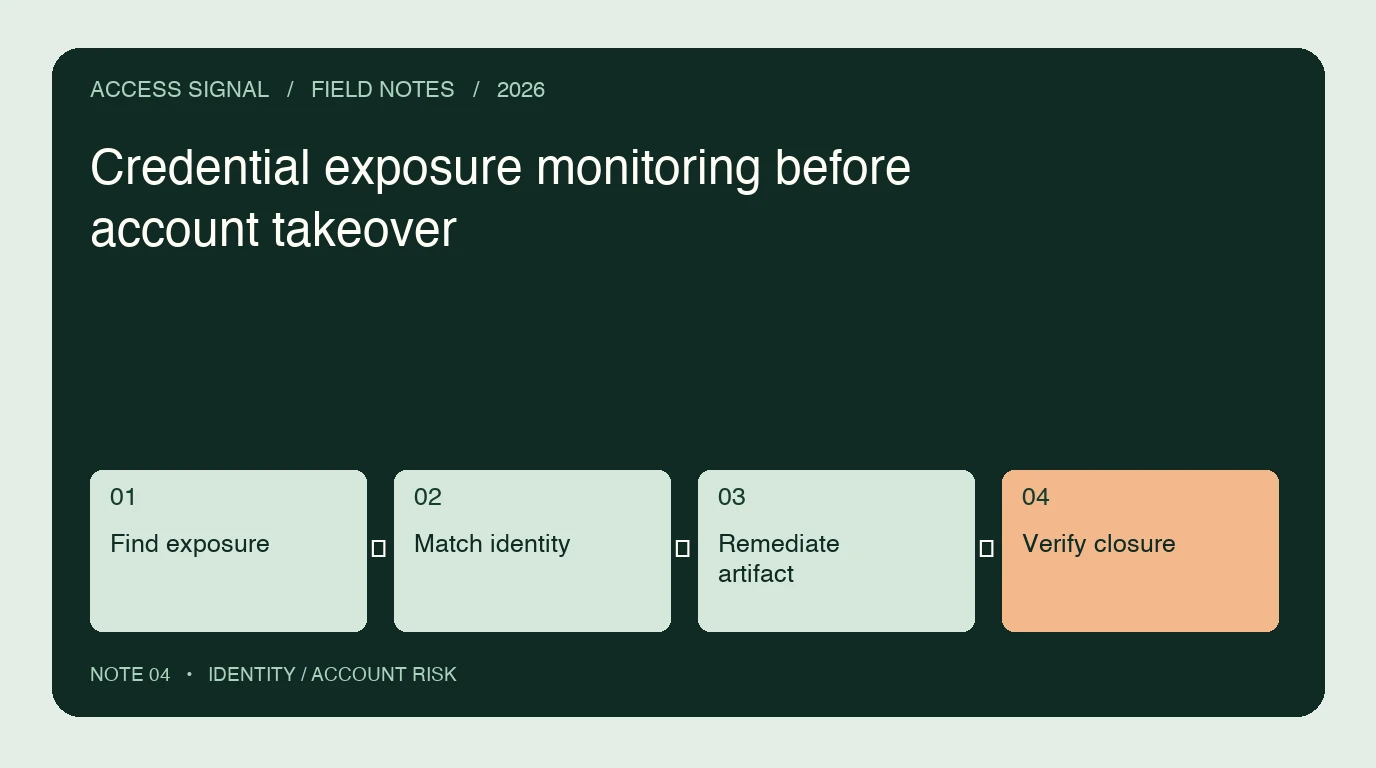
Credential exposure monitoring identifies account information or authentication artifacts found in breach, malware or phishing data. Its value is early remediation: connect the exposure to the correct identity, act on the artifact that was compromised and confirm the response. It complements live login-risk assessment rather than duplicating its input.
- 1Find exposure
- 2Match identity
- 3Remediate artifact
- 4Verify closure
What does exposure monitoring tell you?
An exposure record can indicate that credentials or another identity artifact has appeared in a provider’s recaptured data. The record’s source, time, match method and artifact type matter. A match to an email address does not automatically establish that the current password or active application session is compromised.
Request the fields and definitions available in the product you are evaluating. SpyCloud’s Consumer ATO documentation describes a consumer control path, while workforce protection is a distinct buying scope. Use only identities and records you are authorized to process.
How is this different from live account-risk detection?
Exposure monitoring starts from compromised identity data. Live risk starts from activity arriving at your application: its device, connection and account context. A currently suspicious login may have no known exposure record; an exposed identity may have no observed malicious login yet.
ShieldLabs supplies current device/network and account-risk context. SpyCloud adds recaptured exposure intelligence. The same application may benefit from both if each addresses a documented gap. Keep the source and meaning of the evidence explicit in the case history.
Which artifact needs which response?
| Artifact or finding | Response to verify |
|---|---|
| Relevant exposed password | Protected credential change and follow-up authentication |
| Session cookie | Invalidation of the affected application session |
| Refresh token | Supported revocation at the issuer and confirmation of effect |
| Unwanted delegated grant | Removal of the grant and review of resulting access |
| Historical identity-only record | Validate relevance before applying disruptive action |
This is a planning worksheet, not a guarantee that one product supports every action. SpyCloud’s phishing guidance distinguishes artifacts and remediation paths. The identity provider and applications must supply the required administrative operations.
What should an integration record contain?
Store a stable case reference, protected identity reference, evidence timestamp, exposure category, match confidence as defined by the source and the completed remediation. Minimize retained sensitive data. A case record rarely needs to reproduce a raw password or live token in a support system.
Design for duplicate and updated records. The same identity can appear more than once, and a later record may describe a new artifact. Deduplicate the notification without suppressing a genuinely new exposure. Tie the action to a specific evidence record and make retries safe.
How do you avoid unnecessary resets?
Check whether the record is relevant to the current account, whether the affected credential has already changed and whether the exposure includes a session artifact that survives the proposed reset. Distinguish a confirmed match from an uncertain or historical association.
Repeated disruption can train users to ignore messages and increase support-assisted recovery. Use a protected notification path, explain the required action without revealing secrets and confirm completion. The recovery guide covers token handling and session consequences.
What should a buyer ask during evaluation?
Ask which consumer or workforce identities are in scope, how new exposure is delivered, what the timestamps mean, which APIs and integrations are entitled and what evidence confirms that remediation completed. Test an authorized record through the full workflow, including duplicate delivery and a failed administrative action.
Do not equate the number of exposure records with takeovers prevented. Track relevant confirmed exposures, completed remediation, unresolved cases and customer impact. Combine that view with login-risk evidence and the shared evaluation method.
FAQ
Does an exposed email address prove account compromise?
No. Check the match, artifact type, relevance to the current account and timing. An identity reference alone does not establish that the current password or session was exposed.
Can exposure monitoring replace login-risk checks?
It covers a different input. Recaptured exposure can support earlier remediation; live device/account risk assesses activity reaching the application. Evaluate the gap each control addresses.
Should raw passwords be retained in a case-management tool?
Avoid copying raw secrets into operational records. Keep the minimal references and evidence needed to assess and verify remediation, following the provider’s documented handling and your data requirements.
Sources
Primary sources checked October 23, 2026.
- SpyCloud Consumer ATO documentation
- SpyCloud automated ATO prevention
- SpyCloud phishing intelligence
- OWASP Forgot Password
Continue reading
- How to prevent account takeover across the access journey
- Account takeover risk in passwordless login and sessions
- Secure account recovery after suspicious access
Compare all ten tools or read the complete deployment guide.